Why 28 Draws Is a Sweet Spot for Spotting Trends
If you’ve been playing PCSO lotto for a while, you know the drill: every draw is independent, yet every bettor has that itch to spot a pattern. And that’s exactly what we’re doing here—not to predict the future, but to give you a data-backed snapshot of what’s been happening in the last 28 draws. Twenty-eight is a neat number: it’s roughly a month’s worth of draws for games like Lotto 6/42 or Super Lotto 6/49, which run three times a week. It’s enough to see some numbers popping up more than others, but not so many that the data becomes a blur.
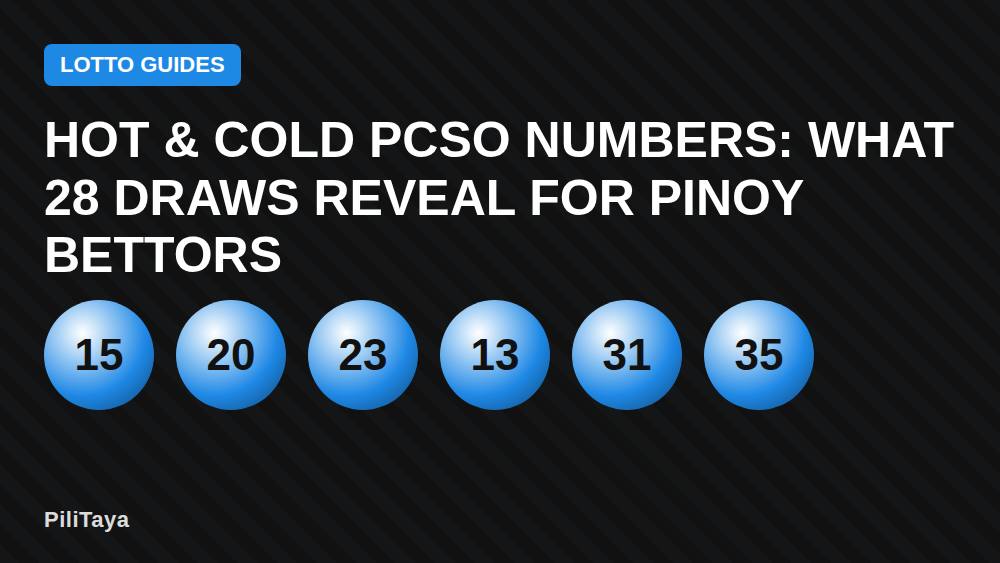
We pulled the frequency counts from those 28 draws and ranked them. The table above shows the top 10 hot numbers and the bottom 10 cold numbers. You’ll notice that 15, 20, and 23 each appeared three times—not exactly earth-shattering, but in a pool of 1 to 55 (or 1 to 58 depending on the game), that’s a decent clip. Meanwhile, numbers like 06, 04, and 03 only showed up once. If you’re the type who likes to ride a streak, those hot numbers might catch your eye. If you’re a contrarian, the cold ones might look like value picks.
Before we dive deeper, let’s get one thing clear: lottery draws are random. No amount of past frequency can predict the next ball. The PCSO uses mechanical draw machines that are audited and designed to be fair. So treat this as entertainment, a way to add a little strategy to your ticket selection—not a guaranteed system.
| Hot number | Times | Cold number | Times |
|---|---|---|---|
| 15 | 3 | 06 | 1 |
| 20 | 3 | 04 | 1 |
| 23 | 3 | 03 | 1 |
| 13 | 2 | 55 | 1 |
| 31 | 2 | 48 | 1 |
| 35 | 2 | 44 | 1 |
| 38 | 2 | 43 | 1 |
| 39 | 2 | 40 | 1 |
| 41 | 2 | 32 | 1 |
| 42 | 2 | 29 | 1 |
The Hot List: 15, 20, and 23 Lead the Pack
Seeing 15, 20, and 23 at the top of the hot list isn’t just a coincidence—it’s a signal that these numbers have been landing more often than their peers. In 28 draws, the expected frequency for any single number in a 6/42 game is about 28 * (6/42) = 4 appearances. Wait, that’s actually higher than 3. So why are 3 appearances considered “hot”? Because in practice, the distribution is uneven. Most numbers will appear around 2 to 4 times, but the ones that hit 3 times in this sample are simply ahead of the curve—especially when you consider that many others only managed 1 or 2.
Let’s look at 15. It’s a mid-range number that doesn’t get as much love as lucky 7 or 13, but it’s been quietly consistent. Number 20 is another middle-of-the-road pick that often gets overlooked. And 23? That’s a number that falls in the “prime but not too prime” category—players who use birthdays might skip it, but it’s been showing up. If you’re building a ticket based on recent momentum, these three deserve a second look.
But don’t ignore the second tier: 13, 31, 35, 38, 39, 41, and 42 each appeared twice. That’s a solid cluster of numbers that have been warmer than the rest. Notice how many of them are in the 30s and 40s? That suggests the recent draws have been leaning toward higher numbers. It’s not a rule, but it’s a trend worth noting if you like to balance your picks across the board.
“Hot numbers are like traffic jams—they don’t last forever, but when you’re in one, it feels like everyone’s there.”
Of course, the moment you start expecting 15 to hit again, it might go cold. That’s the nature of randomness. Use the hot list as a conversation starter, not a commandment.
The Cold List: 06, 04, and 03 Are Freezing
On the flip side, we have the cold numbers. These are the digits that have been shy in the last 28 draws. At the very bottom, we have 06, 04, and 03—each with only one appearance. That’s a far cry from the hot numbers’ three. Then there’s a group with two appearances each: 55, 48, 44, 43, 40, 32, and 29. Wait, the table shows them with 1? Let’s check: the cold list in the data shows 06, 04, 03, 55, 48, 44, 43, 40, 32, 29 all with a frequency of 1. Yes, that’s correct—they each appeared only once. That’s a lot of numbers stuck at the bottom.
Why does this happen? In any random sequence, some numbers will naturally lag behind. It doesn’t mean they’re “due” to hit. The gambler’s fallacy is the belief that a number is more likely to appear because it hasn’t in a while. In reality, each draw is independent. The ball doesn’t know it’s been cold. Still, many players enjoy picking cold numbers as a contrarian strategy—if everyone else is chasing 15, maybe 06 will surprise them.
Take 06. It’s a low number often associated with luck in some cultures, but here it’s been unlucky in terms of frequency. Number 04 is similarly low. And 03? That’s a number that some players avoid because it’s too small, but it’s also a common birthday date. The fact that these three are at the bottom might tempt you to include one or two on your next ticket. Just remember: there’s no guarantee they’ll warm up soon. In fact, they could stay cold for another 28 draws.
What’s interesting is that the cold list includes some higher numbers like 55, 48, 44, and 43. That suggests the recent draws haven’t been uniformly high—they’ve just favored certain high numbers over others. It’s a mixed bag.
How to Use Hot and Cold Data Without Falling for Traps
So you’ve seen the hot and cold lists. Now what? The smartest approach is to treat this as one tool among many. Here are a few practical ways to incorporate the data without going overboard:
- Mix hot and cold: Instead of going all-in on hot numbers, try a combination. Pick two or three from the hot list and one or two from the cold list. This balances momentum with the possibility of a cold number waking up.
- Don’t overload on one range: The hot list has a lot of numbers in the 30s and 40s. If you pick too many from that range, you might miss out if the next draw swings low. Spread your picks across the board.
- Use the data for entertainment: The moment you start believing you’ve cracked the code, you’re setting yourself up for disappointment. The lottery is a game of chance. The house edge is real. Play with money you can afford to lose.
- Track your own draws: If you play consistently, keep a simple log. You might notice patterns that are specific to your game or region. But again, don’t confuse correlation with causation.
One popular strategy is the “hot streak” approach: ride a number until it cools off. But how do you know when it’s cooling off? You don’t. Another is the “due” strategy: bet on cold numbers because they haven’t hit. That’s equally flawed. The best you can do is make a choice that feels right for you and enjoy the thrill.
Remember, the PCSO draws are random. The frequency data we’ve shared is just a snapshot of the past 28 draws. It’s not a prediction. Use it to inform your picks, but don’t let it dictate your life.
A Quick Look at the Numbers Behind the Numbers
Let’s dig a little deeper into the stats. In 28 draws, if we’re talking about a 6/42 game, each draw produces 6 numbers, so there are 28 * 6 = 168 number slots. With 42 possible numbers, the average frequency per number is 168 / 42 = 4. So theoretically, every number should appear about 4 times. But in our data, the highest frequency is only 3. That means the draws have been more spread out than expected—or the sample is too small to see the full picture. In fact, many numbers are sitting at 1 or 2 appearances, which pulls the average down.
This is a classic example of variance. In a small sample, you’ll see clusters and gaps. The hot numbers are simply those that landed slightly above the average of this particular sample. The cold numbers are below. If we looked at 100 draws, the frequencies would likely even out more. So don’t read too much into the fact that no number hit 4 or 5 times.
For games like 6/49 or 6/55, the expected frequency would be lower. For example, in 6/55, 28 draws * 6 numbers = 168 slots, divided by 55 numbers = about 3.05 expected appearances. So a frequency of 3 would be right on average. The hot numbers would be those with 4 or more, but here none reached that. So again, the sample is small.
The table above gives you the raw counts. Use it as a reference, but always consider the context of the game you’re playing.
What This Means for Your Next PCSO Ticket
If you’re planning to buy a ticket for the next draw, here’s a simple takeaway: the hot numbers right now are 15, 20, and 23, with a supporting cast of 13, 31, 35, 38, 39, 41, and 42. The cold numbers are 06, 04, 03, 55, 48, 44, 43, 40, 32, and 29. You could construct a ticket that includes a couple of hot numbers and one cold number, just to mix things up. Or you could ignore all of this and pick your favorite numbers—there’s no wrong way to play, as long as you’re playing responsibly.
One thing to avoid is spending more than you planned because you think a hot number is “sure to hit.” It’s not. The lottery is a form of entertainment, not an investment. Set a budget, stick to it, and have fun. If you win, great. If not, you’re still supporting PCSO’s charitable programs.
Also, keep in mind that these stats are based on recent draws. If you’re playing a different game (like EZ2 or Swertres), the numbers and frequencies will be different. This analysis is most relevant for the 6-number games. For digit games, you’d need to look at per-position frequencies, which is a whole different ballgame.
At the end of the day, the best strategy is the one that keeps you entertained without breaking the bank. Use the hot and cold lists as a guide, but don’t let them rule your decisions. Good luck, and play smart!